
Bio-based epoxy reactive diluent YLD-9016 is a difunctional cardanol diglycidyl ether specified at EEW 250-330 g/eq and 60-150 mPa·s at 25 °C. CAS 68390-54-5, non-volatile content 99.7% minimum, derived from cashew nut shell liquid. At 15 phr the diluent cuts a 13000 mPa·s resin to about 6300 mPa·s.
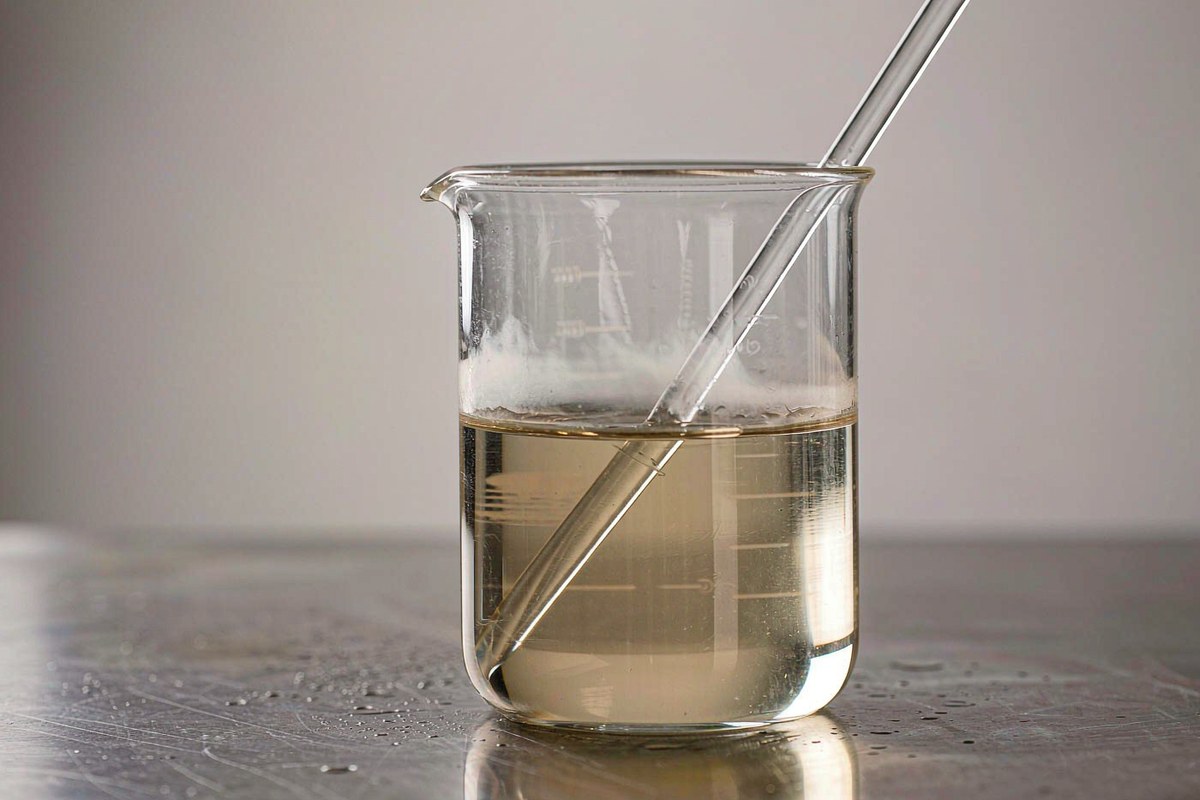
Figure 1. Cardanol diglycidyl ether YLD-9016 is supplied as a light yellowish brown liquid with a Gardner color of 12 maximum and ships in 200 kg drums.
A high-solids epoxy formulation needs its viscosity cut by something that stays in the film. Solvent leaves as VOC; a reactive diluent cures into the network instead. That is the argument for glycidyl ethers.
The cardanol line already covers three answers: cardanol glycidyl ethers YLD-9006 monofunctional at 30-50 mPa·s, and standard cardanol diglycidyl ether YLD-9014 with its variant YLD-9014A difunctional but at 1000-3000 mPa·s. Resin-class flow, not diluent-class flow.
YLD-9016 publishes 60-150 mPa·s with two epoxy groups per molecule. It is the only grade in the family that pairs diluent-class viscosity with difunctional reactivity, on a cashew-derived backbone.
Viscosity is only half the argument.
Specification values below come from the public Yolatech product pages, derived constants are marked calculated, and dosage figures are worked examples.
Table 1 collects the identity and specification data published for YLD-9016.
Table 1. Identity and published specification of bio-based epoxy reactive diluent YLD-9016.
Item |
Information |
Product name |
Cardanol Diglycidyl Ether YLD-9016 |
Chemical family |
Cashew oil modified difunctional glycidyl ether |
CAS No. |
68390-54-5 |
Appearance |
Light yellowish brown liquid |
Color, G |
Max. 12 |
EEW, g/eq |
250-330 |
Viscosity (25 °C), mPa·s |
60-150 |
Non-volatile, % |
Min. 99.7 |
Epoxy functionality |
2 (bifunctional, as published) |
Raw material base |
Cashew nut shell liquid, plant-derived |
Packaging |
200 kg drum |
Shelf life |
12 months in original packing |
Table 1 reproduces the published figures without alteration. The report adds no laboratory data of its own.
Epoxy equivalent weight is determined by titration under ASTM D1652 or ISO 3001, and the figure on the current TDS governs. Color is determined by ASTM D1544, and viscosity is measured at 25 °C under the method stated in the current TDS.
Incoming checks on a glycidyl ether lot are typically run in duplicate, or as n = 3 determinations from separate positions in the drum.
Two published numbers separate YLD-9016 from the cardanol line: 60-150 mPa·s at 25 °C and 99.7% minimum non-volatile.
Cardanol is a meta-substituted phenol carrying a C15 unsaturated alkyl chain, obtained from cashew nut shell liquid. Capping that core with two glycidyl groups gives a rigid aromatic ring, a long hydrophobic tail and two reactive epoxide ends.
Each part does one job. The epoxide ends consume amine and enter the network. The alkyl chain buys flexibility and water repellency. The aromatic ring lets a film harden at room and low temperatures.
Nothing evaporates. A non-volatile content of 99.7% minimum means essentially the whole dose becomes part of the film.
Table 2 places YLD-9016 beside the petrochemical ethers it replaces and the sibling cardanol grades.
Table 2. Property comparison of bio-based epoxy reactive diluent YLD-9016 with alternative reactive diluents (published values).
Property |
YLD-9016 |
YLD-9014 |
AGE YLD-7003 |
BGE YLD-9004A |
HDDGE YLD-6008 |
Epoxy functionality |
2 |
2 |
1 |
1 |
2 |
EEW, g/eq |
250-330 |
290-350 |
294-313 |
147-157 |
142-155 |
Viscosity (25 °C), mPa·s |
60-150 |
1000-3000 |
4-10 |
Max. 2 |
10-25 |
Raw material base |
Cashew, bio-based |
Cashew, bio-based |
Petrochemical |
Petrochemical |
Petrochemical |
Hardener demand vs 187 g/eq DGEBA |
Lowers |
Lowers |
Lowers |
Raises |
Raises |
On raw thinning power the petrochemical ethers win: butyl glycidyl ether BGE YLD-9004 at 2 mPa·s maximum and 1,6-hexanediol diglycidyl ether YLD-6008 at 10-25 mPa·s, against 60-150 mPa·s.
What they give back is hardener demand. At EEW 147-157 and 142-155 g/eq they pull a blend below the 184-190 g/eq of a standard bisphenol A resin, so every added part costs amine. YLD-9016 and alkyl (C12-C14) glycidyl ether YLD-7003 sit above 250 g/eq and push it down.
Color limits are not comparable across the columns: the cardanol grades are limited in Gardner, the petrochemical ethers in APHA.
Where a difunctional petrochemical ether is the incumbent, the product page names 1,4-butanediol diglycidyl ether YLD-6018L as a comparator, published at 98% minimum purity and no EEW window.
Blend EEW and hardener demand follow two equations, with phr read as parts per hundred parts of resin by weight.
Blend EEW = (100 + d) ÷ (100 ÷ EEW + d ÷ EEW9016), where d is the diluent loading in phr
phr = 100 × AHEW ÷ EEW
Table 3. Dilution and hardener dosage worksheet for 100 parts of bisphenol A epoxy resin YLE-128 at 187 g/eq and 13000 mPa·s, blended with YLD-9016 at its 290 g/eq and 105 mPa·s midpoints (calculated).
YLD-9016 loading, phr |
Blend EEW, g/eq |
DETA phr at AHEW 20.6 |
MACM phr at AHEW 60 |
Viscosity estimate, mPa·s |
0 |
187 |
11.0 |
32.1 |
13000 |
10 |
193 |
10.7 |
31.1 |
8400 |
15 |
196 |
10.5 |
30.6 |
6300 |
20 |
199 |
10.4 |
30.2 |
5800 |
Viscosity is estimated by a log-rule blend, which tracks glycidyl ether systems well enough for screening. A 15 phr loading takes an 11000-15000 mPa·s bisphenol A epoxy resin YLE-128 down to about 6300 mPa·s, a 51% cut.
For a 1,000 g resin charge, weigh 150 g of YLD-9016 and 306 g of MACM curing agent at its published AHEW of 60 g/eq. Treat 30.6 phr as a starting point, because the 250-330 g/eq window is 80 g/eq wide.
Dilution efficiency, not price, is the honest basis. No list price is published, so express the trade-off as viscosity reduction per phr and settle it against your own drum quotation. On that basis 15 phr of BGE reaches about 3500 mPa·s and wins on thinning, but YLD-9016 wins on volatile-free composition and hardener demand.
If a formulation has to stay stiff, cap the loading near 20 phr and verify hardness development on the actual system.
Field practice with YLD-9016 reduces to five points.
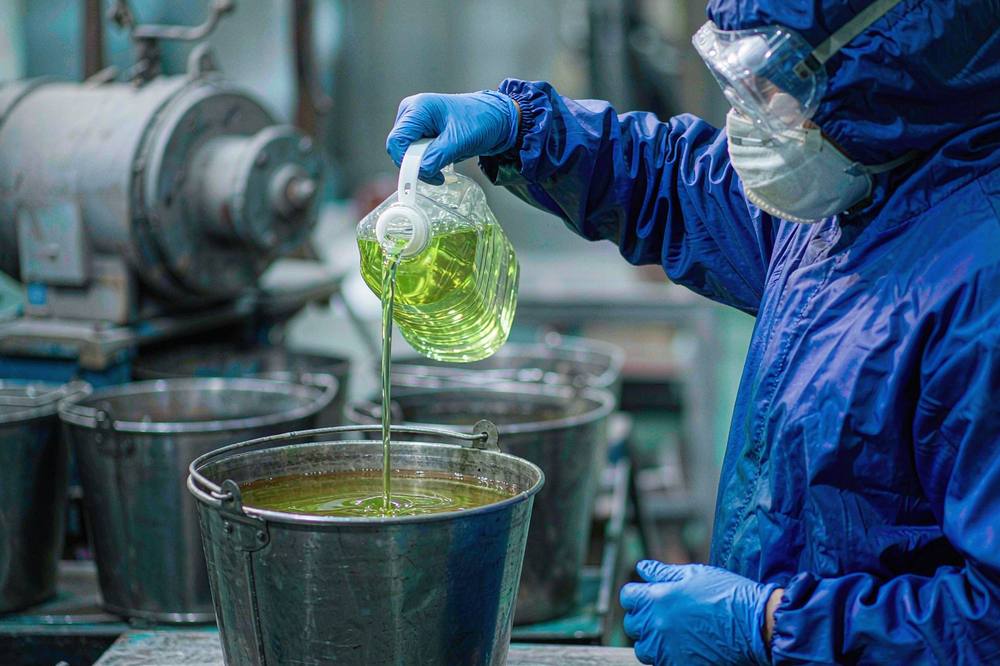
Figure 2. Diluent is poured into the resin and homogenized before the hardener is dosed, keeping the mix stoichiometry under control.
The page lists high-solids and solvent-free coatings, adhesives and composites, plus surface alkylation of silica and titanium dioxide.
Table 4. Application fit for bio-based epoxy reactive diluent YLD-9016 and the resin grades commonly blended with it.
Application |
Why YLD-9016 fits |
Resin companion |
High-solids coatings |
Reactive dilution at 99.7% minimum non-volatile content |
YLE-128 |
Solvent-free 2K systems |
Co-cures into the network instead of leaving as emission |
|
Adhesives |
Flexibility, impact resistance and water resistance |
YLE-128 |
Composites and FRP |
Impregnation aid at diluent-class viscosity |
|
Filler surface treatment |
Alkylates silica and titanium dioxide surfaces |
None |
The coating logic runs through epoxy resin coatings: wherever a solvent-borne recipe converts to high solids, a reactive diluent with a negligible volatile fraction is the direct swap, but the hardener ratio still needs recalculating. Adhesive work is covered in epoxy resin adhesives, impregnation in epoxy resin composites.
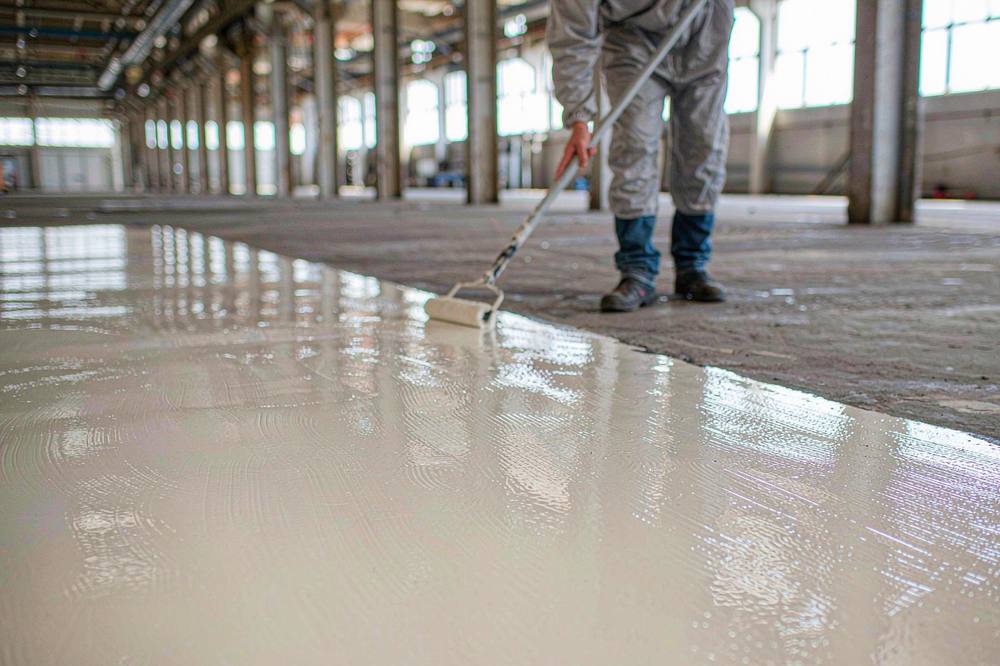
Figure 3. Solvent-free epoxy floor coating applied by roller, the application where reactive dilution replaces solvent entirely.
Four specification gaps deserve confirmation before YLD-9016 is written into a purchase specification.
Hydrolyzable chlorine, water content, density, flash point and molecular formula are not published; the grade gives only a non-volatile floor of 99.7%. Confirm them on the current TDS, MSDS and COA.
The 250-330 g/eq EEW window is 80 g/eq wide, wider than the 184-190 g/eq of YLE-128. Batch drift inside it moves hardener demand by about 3% at a fixed loading.
This grade is not the right choice for a stiff, heat-deflection-critical casting, and it is not a flame retardant: no halogen or phosphorus content is published.
The food-grade statement appears on the YLD-9006 page, not here. Do not carry the claim across without written confirmation.
Incoming inspection should confirm EEW by titration against the lot COA, plus color and non-volatile content. Reject a lot outside 250-330 g/eq.
Packaging is a 200 kg drum with a stated shelf life of 12 months from manufacture in the original packing, stored cool and dry out of direct sunlight.
Handling detail is carried by the Material Safety Data Sheet. Glycidyl ethers are skin sensitisers, so gloves and eye protection belong in the procedure.
RoHS, REACH or UL 94 status has to be confirmed by the buyer against current certificates. A general product description implies no certification.
YLD-9016 is a cardanol diglycidyl ether derived from cashew nut shell liquid, with two epoxy groups per molecule. The page positions it as a non-toxic, renewable alternative to petrochemical ethers such as AGE and BGE.
The difference is viscosity. YLD-9016 runs at 60-150 mPa·s while YLD-9014 and YLD-9014A both sit at 1000-3000 mPa·s; all three share CAS 68390-54-5.
Start between 10 and 20 phr. A log-rule estimate for 15 phr in an 11000-15000 mPa·s bisphenol A resin lands near 6300 mPa·s, and the right level depends on the stiffness the part can give up.
Yes, downward. Its own EEW sits above the 184-190 g/eq of a standard bisphenol A resin, so each added part raises the blend EEW; at 15 phr the calculated MACM demand drops from 32.1 to 30.6 phr.
On thinning alone, no. BGE at 2 mPa·s maximum cuts deeper per phr and usually wins that comparison, so the swap makes sense when volatile content, odor or hardener demand carries more weight than the last third of the viscosity cut.
It adds flexibility by design, which is a trade rather than a defect. The alkyl chain lowers modulus and heat deflection while raising impact and water resistance, and the effect depends on the loading.
Bio-based epoxy reactive diluent YLD-9016 is published at EEW 250-330 g/eq, 60-150 mPa·s at 25 °C, Gardner color 12 maximum and 99.7% minimum non-volatile content, in 200 kg drums with a 12-month shelf life.
Its position is narrow but useful: diluent-class viscosity on a difunctional, cashew-derived backbone, with lower hardener demand than the petrochemical ethers it replaces.
Dose by stoichiometry from the lot COA, cap the loading near 20 phr, and keep the deep-thinning monofunctional ethers for jobs that need them.
1. Product page, Cardanol Diglycidyl Ether YLD-9016, Yolatech: https://www.yolatech.com/cardanol-diglycidyl-ether-yld-9016
2. Product page, Cardanol Diglycidyl Ether YLD-9014, Yolatech: https://www.yolatech.com/cardanol-diglycidyl-ether-yld-9014
3. Product page, Butyl glycidyl ether BGE YLD-9004, Yolatech: https://www.yolatech.com/butyl-glycidyl-etherbge-yld-9004
4. Product page, 1,6-Hexanediol diglycidyl ether YLD-6008, Yolatech: https://www.yolatech.com/16-hexanediol-diglycidyl-ether-yld-6008
5. Product page, liquid bisphenol A epoxy resin YLE-127 / YLE-128, Yolatech: https://www.yolatech.com/bisphenol-a-epoxy-resin
6. Technical Data Sheet, Material Safety Data Sheet and Certificate of Analysis for Cardanol Diglycidyl Ether YLD-9016, Yolatech (available on request).
7. ASTM D1652 and ISO 3001, titration routes for epoxy content and epoxy equivalent weight.
8. ASTM D1544 for Gardner color, ASTM D445 for kinematic viscosity, ASTM E203 for water by Karl Fischer titration.



 Red IPv6 compatible