1,6-Hexanediol Diglycidyl Ether: Low-Viscosity Bifunctional Diluent
Oct 30, 2026
1,6-Hexanediol diglycidyl ether YLD-6008 is a bifunctional water-compatible epoxy reactive diluent with EEW 142–155 g/eq. The published specification adds 10–25 mPa·s at 25 °C, APHA Max. 40 and chloride ceilings. Solvent-free coatings, laminating, adhesives and fiber finishing are the declared uses.
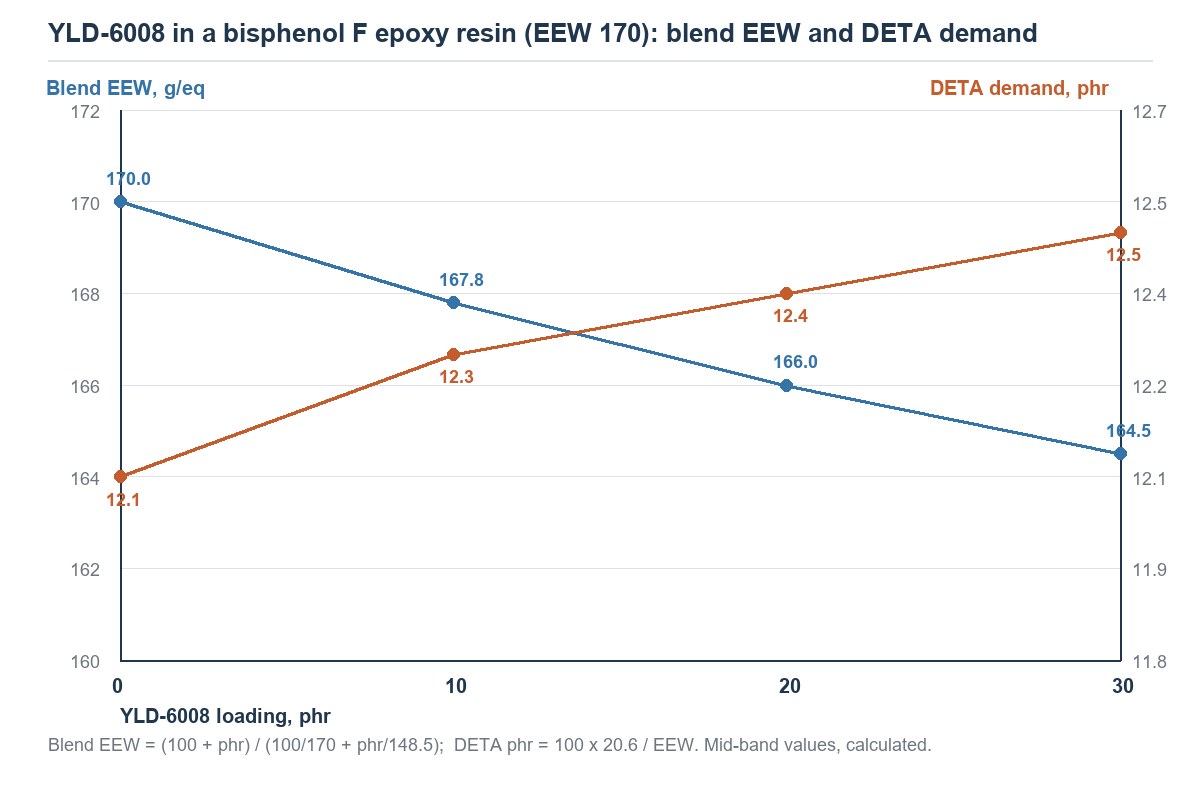
Figure 1. Blend EEW (left) and DETA demand in phr (right) for YLE-170 with 0–30 phr of YLD-6008. Calculated from mid-band values per Section 4.
1. Introduction
Aliphatic diglycidyl ethers sit between mono-epoxy diluents and base resins. Mono-epoxy grades cut viscosity hard but leave a pendant alkyl chain in the network; base resins build the network but arrive at 11,000–15,000 mPa·s. 1,6-Hexanediol diglycidyl ether YLD-6008 (CAS 16096-31-4) takes the middle route: two terminal epoxide rings on a flexible C6 spacer.
This report assembles the published specification of YLD-6008, derives the formulation arithmetic, and marks the boundary of the data. Sources: the public product page (accessed 2026-10-30), values calculated from the molecular formula, and mixing-rule estimates labelled as such.
2. Materials and Methods: Identity and Published Specification of 1,6-Hexanediol Diglycidyl Ether
2.1 Product identity and specification
Table 1 fixes the identity of the grade per the product page and its CAS 16096-31-4 entry. Molecular formula and weight are calculated from the structure of 1,6-bis(2,3-epoxypropoxy)hexane; dividing 230.30 g/mol by two epoxy groups gives a theoretical EEW of 115.15 g/eq.
ItemInformation
Trade nameYLD-6008
Chemical name1,6-Hexanediol diglycidyl ether
CAS No.16096-31-4
Molecular formulaC12H22O4 (calculated)
Molecular weight230.30 g/mol (calculated)
Theoretical EEW115.15 g/eq (calculated, pure monomer)
Table 1. Product identification of YLD-6008; calculated rows are marked as such.
Table 2 lists the seven parameters the product page publishes. The measured EEW band of 142–155 g/eq lies well above the theoretical 115.15 g/eq, so the commercial liquid carries oligomeric species. That is normal for glycidyl ether diluents, and it is why the band, not the monomer value, drives formulation arithmetic.
ItemSpecification
AppearanceTransparent liquid
Color, APHAMax. 40
Viscosity, mPa·s at 25 °C10–25
EEW, g/eq142–155
Hydrolyzable chloride, %Max. 0.2
Inorganic chlorine, ppmMax. 20
Water, %Max. 0.1
Table 2. Published specification of YLD-6008, quoted from the product page accessed 2026-10-30.
2.2 Test methods and data sources
Published values are quoted as the product page states them; calculated values — molecular weight, theoretical EEW, all blend arithmetic — follow from the formulas shown; mixing-rule estimates are indicative only.
For incoming control, epoxy content should be determined by titration per ASTM D1652 or ISO 3001 on each lot, water by ASTM E203 (Karl Fischer), and viscosity checked at 25 °C per ASTM D445. Buyers confirm these in duplicate on large lots. Anything beyond Table 2 should be requested as a certificate value, not assumed.
3. Results and Discussion: Structure and Reactivity of YLD-6008
3.1 What the C6 backbone does
Both ends of YLD-6008 are terminal epoxies, so the molecule is built into the network on each side of the hexamethylene spacer. A mono-epoxy diluent reacts once and leaves a butyl or octyl chain dangling from the crosslink; YLD-6008 instead contributes a flexible segment between two network nodes. Flexibility comes from the spacer, participation from both rings.
Two ether oxygens and short glycidyl arms sit behind the water-compatibility claim: the product page calls the grade a water-soluble reactive diluent with good wetting ability. The claim is qualitative. In practice, check the water budget of your own system first, because the specification allows up to 0.1% water in the drum and moisture pick-up after opening is a known failure path for glycidyl ethers.
Viscosity is the other half of the story.
3.2 Comparison with mono-epoxy reactive diluents
Table 3 lines YLD-6008 up against two mono-epoxy diluents whose specifications the site publishes in the same format. The trade-off shows in three rows: functionality, viscosity, EEW.
AttributeYLD-6008YLD-9004A (BGE)YLD-7004 (C8–10)
Epoxy functionality211
EEW, g/eq142–155147–157220–250
Viscosity, mPa·s at 25 °C10–25Max. 23–10
Hydrolyzable chlorideMax. 0.2%Max. 0.1%Max. 0.2%
Inorganic chlorineMax. 20 ppmMax. 50 mg/kgMax. 20 mg/kg
Published water-compatibility statementYes, water-soluble reactive diluentNot statedNot stated
Table 3. Published parameters of YLD-6008 against two mono-epoxy reactive diluents; all values from the respective product pages.
Butyl glycidyl ether YLD-9004A is the harder viscosity cutter, at a published ceiling of 2 mPa·s and a tighter hydrolyzable chloride ceiling of 0.1%. What it cannot do is react twice. When the diluent must stay in the network — flexibility, wet strength, less extractable material — the bifunctional grade earns its place. YLD-7004 wins on non-polar wetting and filler dispersion up to 15 phr; YLD-2003 publishes 25–45 mPa·s at the same APHA ceiling.
Figure 2. Published viscosity bands at 25 °C (log scale) for YLD-6008, three sibling diluents and two base resins. YLD-9004A is plotted as 0.2–2 against its ceiling of 2.
4. Formulation and Dosage Calculation
Blend arithmetic starts from epoxy equivalents, not from weight fractions. For a resin at EEW_r diluted with w phr of a diluent at EEW_d:
EEW_blend = (100 + w) / (100/EEW_r + w/EEW_d)
Table 4 works the case of YLE-170 (published EEW 160–180 g/eq) diluted with YLD-6008 at the band midpoint of 148.5 g/eq and cured with high-purity diethylenetriamine at a theoretical AHEW of 20.6 g/eq. Hardener demand barely moves: 12.1 to 12.5 phr across the whole 0–30 phr window.
YLD-6008 loading, phr0102030
Blend EEW, g/eq170.0167.8166.0164.5
DETA demand, phr12.112.312.412.5
Table 4. Blend EEW and DETA demand for YLE-170 with 0–30 phr of YLD-6008; calculated from mid-band values.
That flatness is the quiet advantage of a high-EEW bifunctional diluent: it thins the system without forcing a hardener rebalance. The prize is viscosity, not EEW.
How far does viscosity fall? A logarithmic mixing rule on mid-band values gives the estimates in Figure 3: 15 phr of YLD-6008 takes a 13,000 mPa·s bisphenol A resin — the midpoint of the published YLE-128 band (bisphenol A epoxy resin, 11,000–15,000 mPa·s) — to roughly 5,500 mPa·s, against about 4,000 for BGE. Treat both as directional and measure the real blend at 25 °C before it reaches a work instruction.
Figure 3. Estimated blend viscosity at 15 phr loading in YLE-128, logarithmic mixing rule on mid-band published values. Indicative only.
Chloride arithmetic matters when the end use is electrical. At the 0.2% hydrolyzable chloride ceiling, 15 phr of YLD-6008 adds about 261 ppm on a (100 + 15) mass basis; 30 phr adds about 462 ppm. Run it alongside the 20 ppm inorganic chlorine ceiling before any electronics trial.
5. Processing Notes and Operating Window
Add YLD-6008 to the resin side and homogenize before the hardener joins; the order matters less for epoxy equivalents than for wetting.
Start at 10–20 phr for coatings and laminating; push toward 25–30 phr only where flexibility leads. A starting point, not a specification.
Close the drum tightly after each use; keep stock away from flames and sunlight.
Below 15 °C the 10–25 mPa·s band drifts upward; check viscosity at the real shop temperature.
When a chloride ceiling applies, run the ppm arithmetic of Section 4 before the trial.
One rule of thumb covers most shops: pick the loading from the viscosity the process tolerates, then confirm cure behaviour and mechanical properties sit where they did before. Pot life depends on hardener, filler and batch temperature; a jar test at n = 3 replicates is worth the hour.
6. Applications: Where YLD-6008 Is Published to Work
Four use classes appear on the product page; Table 5 pairs each with its pre-scale-up check.
ApplicationPublished role of YLD-6008Check before scale-up
Solvent-free coatingsToughening diluent; cuts viscosity and lets filler loading riseFilm hardness and pot life at plant temperature
Laminating and impregnationBetter wet-out and penetration during castingBath viscosity drift over a working shift
AdhesivesFlexibility at the bond lineLap shear after water soak
Fiber finishingFlexibility, fastness, alkali resistance and dyeability of fiberFastness on the actual fabric
Table 5. Published applications of YLD-6008 and the verification each one needs.
The fiber finishing row is the least generic of the four. It matches the water-compatibility claim, and it is where the C6 spacer competes with textile chemistry rather than with other epoxy diluents.
7. Limitations and Material Verification
7.1 Known limitations and unsuitable uses
YLD-6008 is not a low-chlorine grade. Its 0.2% hydrolyzable chloride ceiling is looser than the 0.1% of BGE and much looser than the 500 ppm total-chlorine specification published for 1,4-butanediol diglycidyl ether YLD-6018L. For electronic encapsulation with tight ionic limits, that difference decides the selection.
Density, flash point, refractive index, gel time and Tg effects are not published for this grade. Do not import them from sibling grades; the glycol spacer shifts all of them. The EEW band also deserves respect: a formulation balanced on the theoretical 115.15 g/eq instead of the 142–155 g/eq band will over-cure.
The band is the spec.
7.2 Incoming verification, packaging and storage
Verify each lot against Table 2: epoxy content determined by ASTM D1652 or ISO 3001 titration, water by ASTM E203, viscosity measured at 25 °C, color on the APHA scale. A duplicate determination per lot costs little compared with a salvaged batch.
Packaging is a drum; shelf life is at least 12 months from manufacture in the original unopened packing at ambient temperature. Storage wording is published: a well-ventilated area, away from flames and direct sunlight, cap closed after each use. Handling detail beyond the page belongs to the MSDS.
8. Frequently Asked Questions
What is YLD-6008 used for in an epoxy formulation?
Cut the viscosity of the base resin, stay in the network as a bifunctional co-reactant, and add flexibility through the C6 spacer. Published uses cover solvent-free coatings, laminating, adhesives and fiber finishing.
How much 1,6-hexanediol diglycidyl ether should be added?
Start at 10–20 phr for coatings, laminating and adhesives; move toward 25–30 phr only when flexibility or wetting demands it. The right value depends on base resin viscosity and the process window; treat every starting number as a first trial point confirmed by measurement.
Is YLD-6008 water soluble?
The product page describes the grade as a water-soluble reactive diluent with good wetting ability. No solubility value is published; read the claim as qualitative. If an aqueous phase is central to your process, request solubility data first.
How does YLD-6008 differ from butyl glycidyl ether?
Functionality first: YLD-6008 carries two epoxide groups against one for BGE. The published EEW bands are close (142–155 versus 147–157 g/eq), while BGE is the stronger viscosity cutter at a ceiling of 2 mPa·s and a tighter hydrolyzable chloride ceiling of 0.1% versus 0.2%. Trade-off, not superiority.
Does YLD-6008 change the amine hardener dosage?
Barely. On a bisphenol F resin at EEW 170, calculated DETA demand rises from 12.1 to 12.5 phr across a 0–30 phr window, because the diluent EEW sits near the resin EEW. Do not expect a hardener cut here.
What should be checked when a YLD-6008 drum arrives?
Epoxy equivalent weight by ASTM D1652 or ISO 3001 titration, water by ASTM E203, viscosity at 25 °C and APHA color, against Table 2. Confirm the drum seal, the 12-month shelf-life window and the storage conditions on the label.
9. Conclusions
YLD-6008 is a bifunctional reactive diluent whose published numbers are internally consistent: EEW 142–155 g/eq, viscosity 10–25 mPa·s at 25 °C, and chloride and water ceilings verifiable by standard titration. Blend arithmetic shows it thins a bisphenol F resin without moving amine demand, which keeps reformulation low-risk on the cure side. The limits are equally clear: a 0.2% hydrolyzable chloride ceiling that rules out tight ionic budgets, and unpublished constants that must come from the TDS or COA.
10. References
[1] Yolatech product page, 1,6-Hexanediol diglycidyl ether YLD-6008: https://www.yolatech.com/16-hexanediol-diglycidyl-ether-yld-6008 (accessed 2026-10-30).
[2] Yolatech Technical Data Sheet, Material Safety Data Sheet and Certificate of Analysis for YLD-6008, CAS 16096-31-4 (available on request).
[3] ASTM D1652, epoxy content of epoxy resins (EEW).
[4] ISO 3001, determination of epoxy equivalent.
[5] ASTM E203, water content by Karl Fischer titration.
[6] ASTM D445, kinematic viscosity.
Leer más






 Red IPv6 compatible